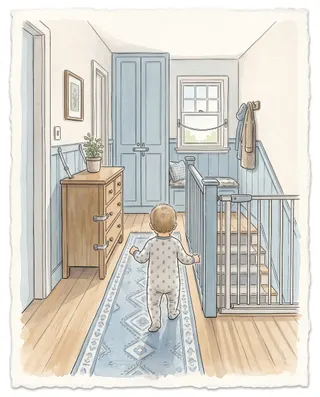
Today your toddler can do what they could not do yesterday: climb onto the windowsill, open a drawer, unscrew a bottle. That is why childproofing is not a one-off job but something you come back to every few weeks, looking at your home from your child’s height. This guide gathers the key rules from official sources. It does not replace a first aid course; ask your clinic about one.
Windows, balconies, stairs
According to NHS, Baby and toddler safety (accessed 2026-11-11):
- fit window locks or safety catches that restrict opening;
- keep low furniture away from windows, because children climb on it;
- use safety gates at the top and bottom of the stairs.
AAP, Home Safety (accessed 2026-11-11) adds: open windows from the top if you can, and a screen is not strong enough to prevent a fall. The AAP also advises avoiding accordion-style gates, which can trap an arm or a neck.
Button batteries and magnets
The NHS warns that small silver button batteries can cause severe internal burns if swallowed; keep them well away from children. The AAP suggests knowing which items in your home have button or coin batteries (remotes, scales, toys, musical cards) and keeping them out of reach. The NHS also advises keeping magnetic toys with small pieces away from young children.
If you suspect your child has swallowed a battery or a magnet, do not wait for symptoms; call your emergency number (112 in Poland and across the EU).
Medicines and cleaning products
According to the NHS, medicines are the most common cause of hospital admissions for poisoning in children under 5. So:
- keep medicines locked away or high up, out of reach and out of sight (NHS);
- the AAP says not to rely on child-resistant caps, and to remember medicines in handbags, yours and visitors’;
- keep cleaning products high up, including toilet products; the NHS suggests choosing products with a bittering agent;
- the AAP suggests safety locks on cupboards with cleaning products and locking away alcohol.
If your child has swallowed something
If you think your child has swallowed a medicine, a cleaning product, a laundry capsule or another chemical, according to NHS, Poisoning (accessed 2026-11-11):
- do not try to make them sick, because they could choke and stop breathing;
- do not give them anything to eat or drink, and do not use home remedies;
- do not wait for symptoms: call 112 (in Poland and across the EU; elsewhere your local emergency number);
- keep the packaging or some of the substance to hand so you can say what it was, and take it with you to hospital.
Water
The NHS says a young child can drown in very shallow water. NHS rules:
- stay with your child the whole time they are in the bath; never leave them alone, even for a moment;
- empty the bath as soon as you take your child out;
- fence off, fill in or securely cover a garden pond;
- empty a paddling pool straight after use and put it away.
CDC, Preventing Drowning (accessed 2026-11-11) stresses that children in or near water, including bathtubs, need close and constant supervision by an adult, even after swimming lessons. The CDC also encourages adults to learn CPR.
Hot drinks, the cooker, the bath
According to the NHS:
- toddlers grab brightly coloured things such as mugs, and a hot drink can still scald long after it was made; keep hot drinks well away from young children and put your drink down out of reach before you pick your child up;
- cook on the back rings and turn pan handles towards the wall;
- run cold water into the bath first, then add hot, and check the temperature with your elbow before your child gets in.
If there is a burn
According to NHS, Burns and scalds (accessed 2026-11-11):
- cool the burn under cool running water as soon as possible; do not stop after a moment, the NHS describes cooling for a long time;
- remove clothing and jewellery near the burn, but do not pull off anything stuck to the skin;
- once cooled, lay cling film loosely over the burn; do not wrap it round;
- do not use creams, oils or butter, do not use plasters, and do not burst blisters.
After any burn in a young child, contact a doctor. Call 112 if the burn is large or deep, is on the face, genitals or bottom, or was caused by electricity or chemicals.
Falls and bumps to the head
Toddlers fall a lot, and usually it ends with a bump. According to NHS, Head injury and concussion (accessed 2026-11-11), call 112 if after a bump to the head your child was knocked out, cannot stay awake or keep their eyes open, has a fit, or their behaviour has clearly changed, for example they are irritable, distracted or lose interest in what is around them. If your child is being sick or anything else worries you, contact a doctor the same day; in Poland, in the evening and on public holidays, use the night and holiday care service (nocna i swiateczna opieka zdrowotna). If a doctor sends you to the emergency department, the NHS advises not driving yourself; ask someone to take you or call 112.
Tipping furniture and TVs
According to AAP, Preventing Furniture and TV Tip-Overs (accessed 2026-11-11):
- anchor furniture to the wall; mount flat-screen TVs on the wall or secure them to furniture;
- never put a TV on top of a dresser, especially in a child’s room;
- heavier things on lower shelves and drawers, lighter ones higher up;
- do not put toys, remotes and electronics up high, where they tempt climbing.
Cords and small things
The NHS advises tying blind and curtain cords up out of reach, because they can wrap around a child’s neck, not leaving dressing-gown cords or drawstring bags lying around, and keeping small objects (buttons, coins, toy parts) out of reach.
The car
According to AAP, Car Seats: Information for Families (accessed 2026-11-11), children should ride rear-facing as long as possible, until they reach the weight or height limit of their seat; the back seat is the safest place. There is more about car seats in the guide “Baby safety”, and the Polish rules on carrying children are below.
Never leave your child alone in the car, not even for a moment. AAP, Prevent Child Deaths in Hot Cars (accessed 2026-11-11) says a car heats up very quickly and cracking a window or parking in the shade does little to help. Lock a car parked at home too, so your toddler cannot climb in alone.
In Poland, carrying children is governed by art. 39(3) to (4) and art. 45(2)(4) to (6) of the Road Traffic Act (consolidated text Dz.U. 2024 poz. 1251, accessed 2026-11-11): a child shorter than 150 cm travels in a child seat or other restraint suited to their weight and height, with a few exceptions set out in the Act, and a rear-facing seat must not be fitted on the front seat with an active passenger airbag. Elsewhere, check the rules where you live.
When something happens: 112
According to gov.pl, Emergency number 112: How to report (accessed 2026-11-11): give the exact address, say briefly what happened, answer the operator’s questions and do not hang up until the operator clearly confirms they have taken the report. In a medical emergency the operator puts you through to a medical dispatcher who helps you help the casualty; put the phone on speaker so your hands are free, and do what they say. Outside the EU, use your local emergency number.
If your child is choking: gagging is loud (coughing, watery eyes, spluttering), choking is quiet, with no cough and no breath. If it is silent, shout for help and call 112. There is more in the guide “Toddler food” and on NHS, How to stop a child from choking (accessed 2026-11-11).
If something worries you but it is not an emergency, call your paediatrician, your family doctor or your clinic.
In short
Look at your home from your child’s height and come back to it regularly. Window locks, stair gates, anchored furniture. Batteries, magnets, medicines and cleaning products high up and locked away; if something is swallowed, do not make your child sick, call 112. Near water, an adult close by the whole time, never stepping away. Cool a burn under cool running water. Rear-facing for as long as possible, and never a child alone in the car. In an emergency call 112 on speaker; for questions, your paediatrician.