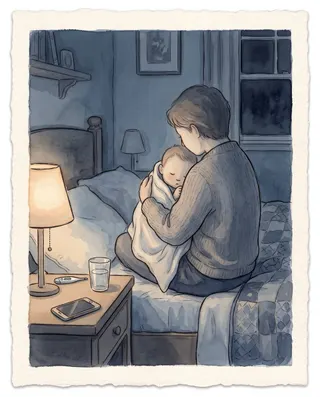
A fever in a baby can be frightening, especially at night. This guide does not say what temperature is “too high” and gives no medicine doses. It helps you decide how quickly to get help, and where. You can always talk to your paediatrician, primary care doctor or midwife about your baby’s health. The places below are in Poland; elsewhere, use your local urgent care and emergency services.
The fever itself
According to NHS, High temperature (fever) in children (accessed 2026-11-11), a fever is the body’s natural response to infection. More important than the number on the thermometer is how your baby looks and behaves: whether they feed, wet their nappies and respond to you as usual.
Measure with a digital thermometer, following its instructions; the NHS describes measuring under the armpit. If your baby has just had a bath or been tightly wrapped, wait a little and measure again.
Newborns and young babies: do not wait
The NHS stresses that in the youngest babies any fever, even one you only suspect, is a reason for urgent contact with a doctor. Do not wait until morning and do not wait for the fever to pass. During the day, call your clinic; in the evening, at night and on holidays, go to night and holiday care; and if you see any of the emergency signs below, call 112.
When to see a doctor the same day
According to the NHS, contact a doctor urgently, the same day, if your baby:
- has a fever and is a newborn or a young baby,
- has a fever together with a rash or other signs of illness,
- will not feed or is not their usual self and you are worried,
- shows signs of dehydration: drier nappies, sunken eyes, crying without tears,
- is vomiting or unusually sleepy,
- has had a fever for several days.
Where: during opening hours, your primary care (POZ) clinic. According to NFZ, Night and holiday health care (in Polish, accessed 2026-11-11), for a sudden illness without an immediate threat to life, help in the evening, at night and on days off comes from night and holiday care; you can go to any point, wherever you live. You can find addresses on the NFZ and pacjent.gov.pl websites or through the free NFZ line 800 190 590. It is worth finding your nearest point now, before you need it.
When to call 112
According to the NHS and NHS, Meningitis (accessed 2026-11-11), call 112 or go to the emergency department (SOR) if your baby:
- has difficulty breathing: grunting, sucking in under the ribs, breathing very fast,
- has blue, grey, very pale or blotchy skin, lips or tongue,
- has unusually cold hands and feet,
- is floppy, hard to wake or not responding as usual,
- has a fit,
- has a weak, high-pitched or unusual cry and cannot be settled,
- has a stiff neck or a bulging soft spot on the head,
- has a rash that does not fade under pressure: press the side of a clear glass against the skin; if the spots are still visible through the glass, that is an emergency sign.
The NHS reminds you that not every child with a serious infection has a rash, and says to trust your instincts: if you feel something is seriously wrong, get help straight away. According to the NFZ, you can go to the SOR without a referral. When you call 112, according to pacjent.gov.pl (accessed 2026-11-11), you answer the dispatcher’s questions, follow their instructions and do not hang up until they end the call. Outside Europe, call your local emergency number.
Care at home
According to the NHS:
- offer the breast or milk often; keep breastfeeding as usual,
- watch for signs of dehydration,
- check on your baby regularly, including during the night,
- do not undress your baby or sponge them with water to cool them down,
- do not cover them with too many clothes or blankets either.
Medicines: what not to do
- Do not give fever medicine without advice from a doctor or pharmacist, and never give it on your own to a newborn or young baby. The NHS lists ages and situations in which common fever medicines are not given, so always ask whether a medicine is suitable, and which one, for your baby’s age and weight. The app gives no doses.
- Never give a child aspirin (NHS).
- Do not alternate two different fever medicines unless a doctor tells you to (NHS).
- If your baby has had medicine and you are still worried, or it is not helping, contact a doctor.
What to prepare before the visit
- Note when the fever started, the readings and when you took them, what and how often your baby has fed, and how many wet nappies there have been.
- Note any medicines your baby has had and when.
- Bring your child’s health booklet.
In short
Watch your baby, not just the thermometer. With a newborn or young baby who has a fever, do not wait until morning: a doctor the same day, and night and holiday care in the evening. Trouble breathing, blue or blotchy skin, floppiness, a fit, a bulging soft spot or a rash that does not fade under a glass: call 112 straight away. No medicines on your own, never aspirin, no cooling with water and no overwrapping.
If you are unsure about anything, contact your paediatrician, primary care doctor or midwife. In an emergency call 112 or your local emergency number.