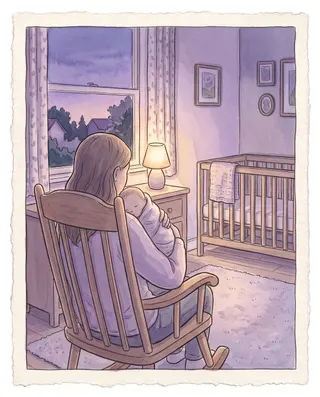
Some evenings your baby cries and you try everything in turn and nothing works. It is one of the hardest parts of the early months, and it does not mean you are doing something wrong. This guide expands the short “Why newborns cry so much” card in the Learn tab. If the crying worries you, talk to your paediatrician or midwife.
Check the basics first
According to NHS, Soothing a crying baby (accessed 2026-11-11), crying is how a baby tells you they need something. Common reasons are:
- hunger,
- a wet or dirty nappy,
- tiredness,
- wanting a cuddle,
- wind,
- being too hot or too cold,
- boredom or too much stimulation.
Colic: what is known
According to NHS, Colic (accessed 2026-11-11), colic is when a baby cries a lot and there is no obvious cause. It is common and usually passes with time. Crying is often worse in the afternoon and evening. The baby may be hard to settle, clench their fists, go red in the face, draw their knees up or arch their back, and their tummy may rumble or they may be very windy.
The NHS notes that crying for other reasons, such as hunger, wind, reflux or constipation, can look similar. So do not diagnose it yourself: talk to your paediatrician about what might be behind it.
Things to try
The NHS and HealthyChildren.org (AAP), Calming a Fussy Baby (accessed 2026-11-11) suggest things that help some babies. Not all of them will work for you, and that is fine:
- hold and cuddle your baby, carry them in your arms or in a sling,
- keep your baby more upright during feeds so they swallow less air, and wind them afterwards,
- gently rock your baby over your shoulder, in a crib or in a pram; a walk can help too,
- try a warm bath, although some babies dislike it,
- put on gentle background noise,
- stroke your baby’s back while holding them against you,
- a dummy or the chance to suck often calms babies,
- swaddle only if a midwife or doctor has shown you how; for sleep your baby always goes down on their back, and according to HealthyChildren.org (AAP), Swaddling (accessed 2026-11-11) you stop swaddling as soon as your baby shows signs of trying to roll over.
If your baby falls asleep in a car seat, the NHS advises moving them to a firm, flat surface as soon as possible.
The NHS stresses that you keep feeding as usual; a breastfeeding mother does not need to change her diet. Any change of formula is a decision for your paediatrician.
What not to do
- Do not give your baby anything for colic on your own. The NHS does not recommend anti-colic drops, herbal remedies or probiotics, as there is no evidence they help. Polish paediatricians sometimes recommend a specific product; if your paediatrician recommends one for your baby, follow their advice.
- Do not give fennel tea or fennel oil; the Polish PTGHiZD position advises against them for young children because there is no safety data.
- Do not use spinal manipulation or cranial osteopathy; according to the NHS there is little evidence they work and they may hurt your baby.
When you feel you cannot cope
Anger, helplessness and wanting to escape during long crying are common feelings. What matters is what you do with them. The NHS and HealthyChildren.org (AAP), Abusive Head Trauma (accessed 2026-11-11) recommend a simple plan:
- Take a deep breath.
- If nobody can take over, put your baby down on their back somewhere safe: a cot or pram with no blankets or soft toys.
- Step into another room for a short while and close the door. Calm yourself: music, a call to someone close, a simple task.
- Check on your baby every few minutes, but do not pick them up until you are calm.
- Go back and try again. Call your paediatrician, as there may be a medical reason for the crying.
Never shake a baby. The NHS warns that shaking can cause serious brain damage, however tired or frustrated you feel. The AAP adds that it is never safe to throw, hit, slam or jerk a child.
If you are afraid you might hurt your baby or yourself, call 116 123 (accessed 2026-11-11), a free support line for adults in crisis in Poland, or 112. It is a request for help, not an admission of guilt.
The AAP recommends that everyone who looks after your baby, your partner, grandparents, a babysitter, knows about this danger. Ask them directly what they do when a baby cries for a long time, and share the plan above.
A plan for a hard evening
- Agree shifts with your partner or someone close before a crisis hits.
- Note when and how long your baby cries, feeds and sleeps. The NHS suggests showing such notes to your doctor; you can keep them in the app’s diary.
- Ask for help early. Talking to your midwife, paediatrician or other parents often helps more than another tip from the internet.
- If your mood worries you, read the “Postpartum” guide and talk to your doctor.
When to contact a doctor
According to the NHS (Colic, High temperature (fever) in children, Meningitis, accessed 2026-11-11) and the AAP, how urgent it is depends on what you see.
Talk to your paediatrician or midwife at the next visit if:
- the crying worries you, nothing helps or you are finding it hard to cope,
- your baby often spits up, is fussy after feeds, or you feel they are not growing as they should.
Contact a doctor the same day, at your clinic, or in the evening, at night and on holidays through night and holiday care (accessed 2026-11-11), if your baby:
- has a fever, or you think they do,
- seems unwell or is not their usual self,
- will not feed,
- is vomiting,
- has clearly fewer wet nappies than usual,
- cries differently from before.
With a newborn or a young baby who has a fever, do not wait until morning. See the guide “A sick baby and fever” for more.
Call 112 or go to the emergency department (SOR) if the cry sounds different from usual, weak or very high-pitched, or if your baby:
- has a fit,
- has blue, grey, very pale or blotchy skin,
- is floppy, hard to wake or not responding as usual,
- has trouble breathing,
- has a rash that does not fade under a pressed glass,
- has a bulging soft spot on the head,
- vomits green or has blood in their poo,
- may have been injured, for example by a fall or a knock to the head.
The NHS says: trust your instincts if you feel something is seriously wrong. Outside Europe, call your local emergency number.
In short
Check the basics, try calm soothing and give nothing without your paediatrician. When emotions take over, put your baby down safely and step away for a moment; 116 123 and 112 are there to be called. Never shake a baby, and tell everyone who cares for your baby the same. A fever, not feeding, or a baby who looks unwell: a doctor the same day.
If you are unsure about anything, contact your paediatrician, doctor or midwife. In an emergency call 112 or your local emergency number.